
From the moment the first call to prayer echoed across the desert sky of seventh century Arabia, the mosque became more than a building. It became a heartbeat.
In the earliest days of Islam, the mosque was simple, walls of clay, a roof of palm branches, and a floor of sand. Yet within those humble boundaries, communities were formed, knowledge was shared, and history was quietly shaped. The first mosque established by the Prophet Muhammad ﷺ in Madinah set the tone. It was a place of prayer, but also of consultation, learning, charity, and shelter.
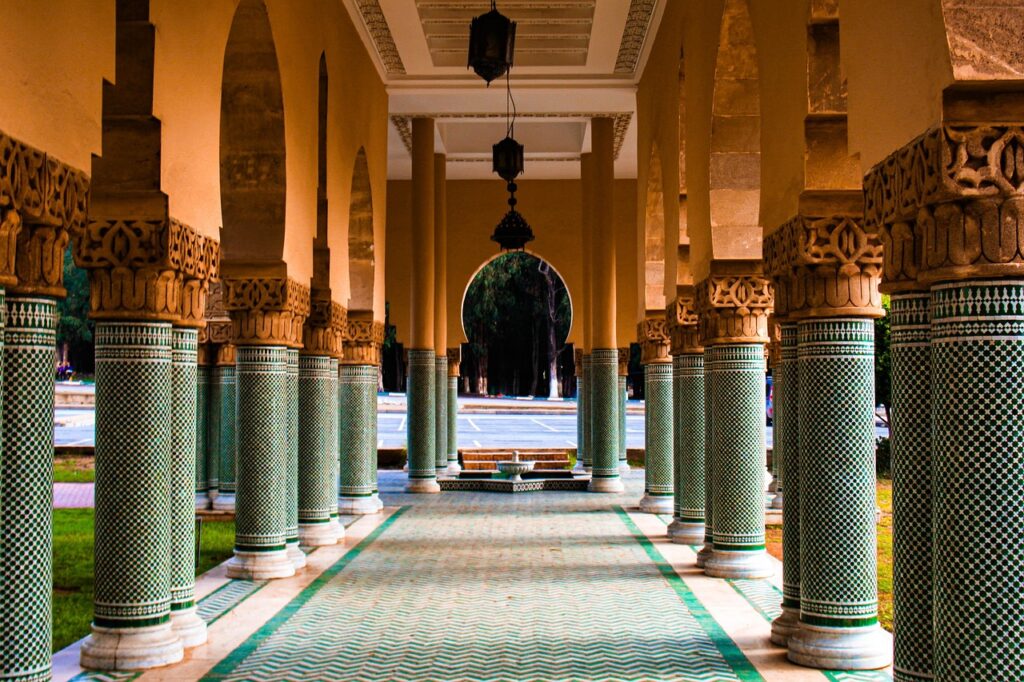
As Islam spread beyond Arabia into Africa, Persia, and the Mediterranean, mosques began to reflect the cultures they touched. Stone replaced mud. Domes rose toward the sky. Minarets pierced city skylines. Calligraphy wrapped itself around arches, turning walls into living verses. Each region left its signature, Ottoman elegance, Andalusian geometry, Mughal grandeur, yet the purpose remained unchanged.
Mosques became centers of civilization. Scholars debated theology beneath their lamps. Travelers rested in their courtyards. Rulers announced policies from their pulpits. In cities like Cairo, Damascus, and Istanbul, the mosque stood not at the edge of society, but at its center.
And still today, whether grand or modest, the mosque carries the same quiet promise, a place to stand shoulder to shoulder, equal before God.
Architecturally, mosques evolved with remarkable creativity.
The hypostyle halls of early Arabia gave way to the great domes of Ottoman lands and the intricate tilework of Persia. In West Africa, earthen mosques rose from the soil itself. In China, curved roofs echoed local traditions. Despite these differences, every mosque points toward Makkah, uniting diverse designs in a single direction of worship.
What makes the mosque enduring is not marble or mosaic, but memory.
Generations pass through its doors, children learning their first verses, elders offering whispered prayers, families gathering in Ramadan nights. Within its walls, joy and grief alike are carried in prostration.
The mosque has survived empires rising and falling. It has witnessed conquests, colonization, reform, and revival. Some were reduced to ruins, others restored to splendor, yet the institution itself never disappeared. Wherever Muslims settled, on islands, in deserts, in bustling modern capitals, the mosque was among the first structures to rise.
In many ways, the history of mosques mirrors the history of the Muslim world, diverse, resilient, and deeply rooted in faith. Their architecture tells stories of trade routes and artistic exchange. Their inscriptions preserve languages and devotion. Their courtyards remember footsteps of scholars, saints, and ordinary believers whose names history may not record, but whose prayers shaped communities.
Today, mosques continue to adapt. Some are built of glass and steel, designed for growing urban populations. Others are converted houses or small neighborhood spaces serving tight knit communities. Technology now amplifies the call to prayer, and sermons can reach across continents in seconds.
Yet the essence remains beautifully unchanged.
A mosque is still a place where the world slows down. Shoes are left at the door. Lines are formed without regard for wealth or status. Foreheads touch the ground in humility. In that moment, centuries collapse into one continuous act of worship.
The story of the mosque is not finished. It is written daily, wherever believers gather, turning ordinary ground into sacred space.